

Native Plant Garden
Find some inspiration!
This blog aims to answer common questions about native plant gardens. We hope this information enhances your enjoyment of the library’s gardens and landscaping. The Parkland Community Library would like to thank The Friends of PCL for their generous donation, which has made this project a success.

Go Native
The key principle of native plant gardening is selecting plants that will survive and thrive in the microclimate of your landscape. Native plants are excellent for low-maintenance landscaping. Once established, the gardens will require minimal watering and fertilizing, and there’s no need to use chemicals or pesticides.

Sunlight, water, and soil type are the main factors in determining what plants to select. First, a gardener must evaluate the light requirements of each plant. Next, consider whether the ground is composed of clay, sand, or is nutrient-rich. How much water does the area receive? Is the spot boggy, dry, on a slope, etc? The purpose of creating a native plant garden is to utilize the right plants in the microenvironment, allowing them to thrive and provide food and shelter for wildlife.
In the case of PCL, Stacey E. Nash, RLA & Sue Tantsits, PCH-SLC, prepared the landscaping to buffer the north wind, provide wildlife cover and food, stabilize slopes, create shade, improve water quality, and add seasonal interest. Plants were grouped in masses for ease of visual interest and continuity. Hardscaping was thoughtfully placed throughout the area to add visual interest, shelter, and stability.
A Case for Native Plants
Over the past century, urbanization has taken intact, ecologically productive land and fragmented it with lawns and exotic plants. The United States has lost approximately 150 million acres of habitat and farmland to urban sprawl, and this trend is expected to continue. The obsession with manicured lawns encompasses over 40 million acres, resulting in a green monoculture. Human landscapes no longer support healthy ecosystems, and remaining natural areas are too small for wildlife.
Why natives
Native plants occur naturally in their respective regions and are vital to ecosystems, supporting a wide range of insects and birds. For example, native oak trees support over 500 caterpillar species. This trees also provides nourishing acorns for wildlife. Decorative trees planted for visual interest, like ginkgos, native to China, host only five species. Raising a brood of chickadees requires over 6,000 caterpillars, highlighting the importance of native plants.

Featured Plants
When creating a visual impact in a garden, plants should be placed in masses to enhance visual interest and continuity. Maintenance, including weeding and watering, will be required until the plants are established. Red tubular flowers attract ruby-throated hummingbirds.
A brief note about plant identification: Please note that some plant identifications may not be entirely accurate. This blog represents a passion project developed by the marketing coordinator of Parkland Community Library. She is not a botanist or professional landscaper, but a passionate advocate for the natural environment.
Plant identification was conducted through research, with most verifications obtained with assistance from Edge of the Woods Nursery when possible.

Mid-April
A few spring teasers to the grander show in May!
Eastern Redbud tree, Cercis canadensis
Golden Ragwort, Packera aurea. (Yellow “starburst” flowers)
Jacob’s Ladder, Polemonium reptans
Pussytoes, Antennaria spp.

Mid-April
A few spring teasers to the grander show in May!
Eastern Redbud tree, Cercis canadensis
Golden Ragwort, Packera aurea. (Yellow “starburst” flowers)
Jacob’s Ladder, Polemonium reptans
Pussytoes, Antennaria spp.

April
Fothergilla, commonly known as witch-alder
Northern Spicebush (Lindera benzoin) is a deciduous shrub native to eastern North America.
- Aromatic: Both the leaves and twigs emit a sweet, spicy fragrance when crushed.
- Wildlife Value: The shrub is a vital host plant for the Spicebush Swallowtail butterfly and produces red berries in the fall that are high in fat, providing essential energy for migrating birds.
Golden Alexander (Zizia aurea)
Host Plant to: Black Swallowtail Butterfly
Red Chokeberry (Aronia arbutifolia)
Fothergilla, commonly known as witch-alder

May
1. Eastern Red Columbine, Aquilegia canadensis
2. California Jacob’s ladder, Polemonium californicum
3. Green and Gold, Chrysogonum virginianum
4. Golden Groundsel, Golden Ragwort, Butterweed, Packera aurea
May
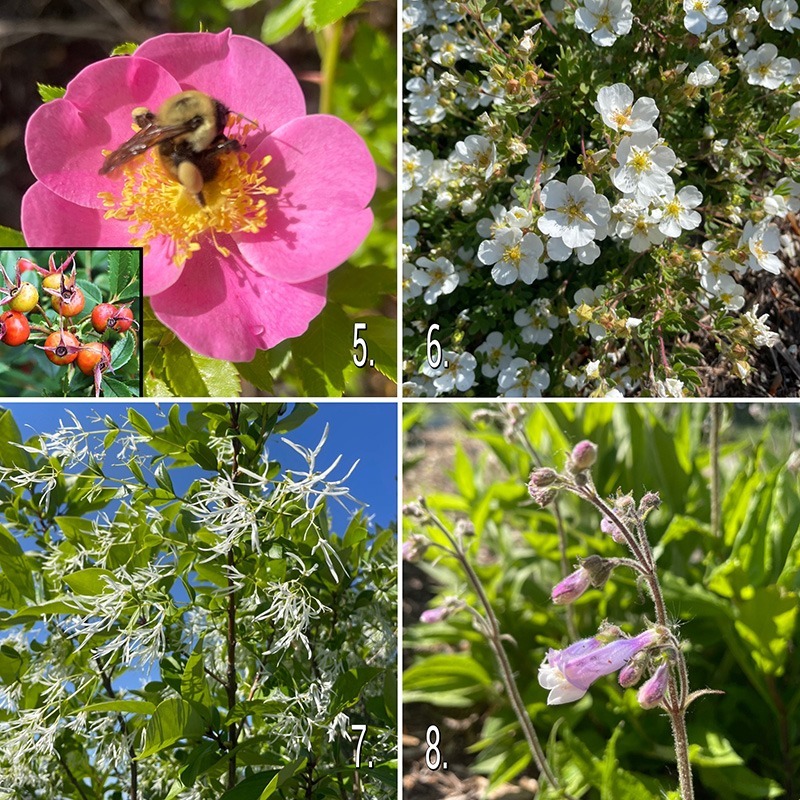
5. Carolina Rose, Rosa carolina (Inset: rose hips appear in the fall).
6. White Potentilla, Potentilla fruticosa ‘White Lady’
7. White Fringetree, Chionanthus virginicus (Garden by the main entrance).
8. Northeastern Beardtongue, Penstemon hirsutus
Blooms
Native plant gardens provide food and shelter for all forms of wildlife with year-round visual interest. The garden comes alive with blooms at the end of April. Most start blooming in May through early June. Blossoms change to seeds, and some plants and shrubs bloom into the fall.
Summer Months
June-August

Late May & June
- Garden phlox, Phlox paniculata
- Cardinal flower, Lobelia cardinalis
- Scarlet bee balm, Monarda didyma
- Blue flag, Iris versicolor

June
5. Summersweet, Sweet Pepperbush, Clethra alnifolia
6. Purple coneflowers, Echinacea purpurea
7. Oakleaf Hydrangea, Hydrangea quercifolia
8. Lanceleaf Coreopsis, Coreopsis lanceolata

9. Buttonbush, Cephalanthus occidentalis. Blooms June-September. White flowers turn red as seeds.
10. Virginia Sweetspire, Itea virginica
11. Common Blue-eyed Grass, Sisyrinchium albidum. Blooms from spring to early summer.
12. Blue Mistflower, Conoclinium coelestinum. Blooms late summer to fall.

July
A. Spotted Joe-Pye Weed, Eupatorium maculatum
B. Blazing Star, Liatris spicata
C. Virginia Mountain Mint, Pycnanthemum virginianum
D. Butterfly Weed, Asclepias tuberos
Late August
Spotlight Goldenrod
The plant in the image is Goldenrod (genus Solidago). These plants are native to North America and are known for their bright yellow flowers, typically blooming from late summer to fall. Other types of Goldenrod are Canada Goldenrod, Solidago canadensis, or Tall Goldenrod, Solidago altissima.

- Appearance: Goldenrods are perennial forbs that can grow several feet tall. They feature dense, clustered spikes of small, bright yellow flowers and oblong, lance-shaped leaves.
- Pollinator Support: Goldenrod is a vital food source for many pollinators, including bees and monarch butterflies, especially during late summer and fall migration. It’s pollon is sticky.
- Care: Goldenrods are generally drought-tolerant once established, but benefit from regular watering during dry periods. They don’t typically require much fertilization but can be pruned in early spring to manage size and promote bushier growth.
- Allergy Myth: Despite common belief, goldenrod is not typically the cause of hay fever allergies. Ragweed, which blooms at the same time, is the more common culprit.
Fall Months
September is a perfect time to visit the garden. Asters are in full bloom with busy pollinators gathering food for winter, along with migrating butterflies and birds.

Late August-September
- Smooth Blue Aster, Symphyotrichum laeve
- Hairy False Golden Aster, Heterotheca villosa
- False Aster, Boltonia asteroides
- Closed Gentian, Blind Gentian, Gentiana andrewsii

August-September
5. Black-eyed Susan, Rudbeckia hirta
6. Calico Aster, Symphyotrichum lateriflorum
7. ‘Autumn Bride’ Coral Bells, Alumroot, Heuchera villosa

Ready to learn more? Check out our booklist!
This collection is for green thumbs: titles to help patrons design and maintain wildlife habitats with native plants, understand and attract pollinators and other garden allies (such as bees, bugs, birds, and butterflies), and share conservation tips. It even includes a few books for children to engage with and nurture their love of outdoor spaces.

Catalog Features
Welcome to Aspen We are excited to introduce an improved Aspen library experience. Explore our updated catalog with new features! Enjoy faster searches and see all available formats in your results. Titles are now grouped by format, including audiobooks, large print, Playaways, and more. Aspen has upgraded the rating system for a straightforward, user-friendly experience.…
October News
2026 It is time for spooky season! Be sure to visit and explore our collection of spooky tales and eerie stories this season. Whether you want a terrifying read or a spectral adventure, we have options for every fan of the macabre. Join us at the Parkland Community Library this fall for all the fun…

The Local Fold
A PCL Communizine: CALL FOR SUBMISSIONS What is Parkland making? Parkland Community Library is creating a community zine filled with art, writing, photography, and creative work made by the people who live here. For our first issue, we’re inviting Parkland residents to submit original work by November 30, 2026, for a chance to be included…